
Revolutionary War History of Union NJ | America Turns 250
On July 4, 2026, the United States turns 250 years old. The tall ships will gather in New York Harbor, the fireworks will light up the sky from coast to coast, and Americans everywhere will celebrate the founding of this nation. But if you really want to stand where the Revolution happened — where musket balls flew, where a woman’s death became a rallying cry for independence, and where the British invasion of New Jersey was stopped cold — you don’t need to go to Philadelphia or Boston. You need to drive to Union Township, New Jersey.
Most people know Union Township as an affordable, well-connected suburb — a place with good highway access, solid housing stock, and a short commute to Newark and New York City. What many don’t realize is that the ground beneath those split-levels and Colonials is some of the most significant Revolutionary War terrain in the country. This is where the British Army’s last major invasion of the northern colonies was turned back. This is where a minister’s wife was killed inside her own home and became a symbol of the Patriot cause. And this is a township where the street names themselves — Colonial Arms Road, Battle Hill Terrace, Caldwell Avenue, Liberty Avenue — tell the story of what happened here 246 years ago.
🗓️ America Turns 250 on July 4, 2026
The national Semiquincentennial (America250) celebration marks the 250th anniversary of the Declaration of Independence. New Jersey — where more battles were fought than in any other colony — is at the center of it. Union Township and Union County are hosting special programming throughout 2026, including a June 24 presentation at Trailside Nature & Science Center exploring the Battles of Connecticut Farms and Springfield through historic maps, pension records, and archaeological finds.
This post covers: The Battle of Connecticut Farms · The story of Hannah Caldwell · Liberty Hall & Governor Livingston · The street names that carry the history · Where to see it all today
⚔️ Before It Was Union, It Was Connecticut Farms
Renamed Union in 1808
The area we now call Union Township was settled in the 1660s and 1670s by families from Connecticut who established a farming community they named Connecticut Farms. It was a modest settlement centered around a Presbyterian meetinghouse on what is today Stuyvesant Avenue — farmland, orchards, and a small cluster of homes along the roads connecting Elizabethtown to the Watchung Mountains.
For more than a century, Connecticut Farms was a quiet agricultural community. But its geography made it strategically critical once the Revolution began. Sitting between the British garrison in New York City and George Washington’s Continental Army encamped at Morristown, Connecticut Farms was directly in the path of any British advance through the Hobart Gap in the Watchung Mountains. By 1780, this quiet farming village had become a battlefield.
The township was officially renamed Union in 1808, but the old name lives on in the Connecticut Farms Presbyterian Church at 888 Stuyvesant Avenue — the same congregation that witnessed the battle firsthand, and whose cemetery still holds a mass grave of British and Hessian soldiers killed in the fighting.
🔥 June 7, 1780: The Battle of Connecticut Farms
Last Major Northern Battle
By the spring of 1780, the Revolutionary War had dragged on for four years. Washington’s army at Morristown had just survived the worst winter of the century — worse even than Valley Forge. Twenty-eight snowstorms hit that season. The waters around New York City froze solid. Soldiers were unpaid, undersupplied, and deserting. British intelligence reported that the Continental Army had been reduced to roughly 3,500 men and was plagued by mutinies.
Hessian Lieutenant General Wilhelm von Knyphausen, commanding the British garrison in New York while General Clinton was away capturing Charleston, saw an opportunity. On the night of June 6, he loaded roughly 6,000 British and Hessian troops onto boats on Staten Island. By midnight, they began landing at Elizabethtown Point. Their objective: push west through the Hobart Gap, reach Morristown, and destroy Washington’s weakened army.
It didn’t go as planned.
The Battle, Hour by Hour
The British columns advanced up what is now Morris Avenue, turning onto present-day Colonial Avenue and pushing toward Chestnut Street and Stuyvesant Avenue. Brigadier General William Maxwell deployed 1,500 Continental troops and local militia in the woods along the route, ordering them to hide and fire at the advancing enemy from cover. The heaviest fighting raged from roughly 8:00 a.m. to 11:30 a.m. A cannon duel broke out in the afternoon at the Rahway River bridge — American guns on Liberty Avenue trading shots with a British cannon on Morris Avenue.
The British fought their way through Connecticut Farms but at a heavy cost. Knyphausen’s forces suffered nearly 200 casualties. Exhausted and realizing the militia resistance was far fiercer than his intelligence had promised, Knyphausen halted for the night and ultimately withdrew back toward New York. The advance on Morristown had failed.
✅ The Battle of Connecticut Farms was one of the last major engagements between British and American forces in the northern colonies during the entire Revolutionary War.
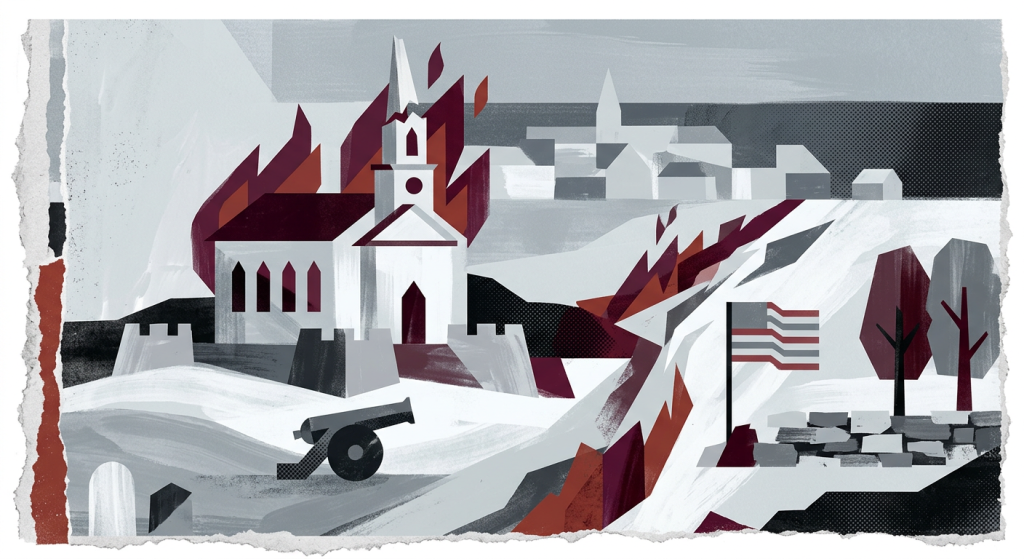
The retreating troops left a trail of destruction. They plundered the village and burned at least a dozen homes, the Presbyterian church, and the parsonage. But the damage they inflicted would pale in comparison to the political cost of what happened inside that parsonage.
🕯️ Hannah Caldwell: The Death That Changed a War
Caldwell Parsonage · 909 Caldwell Ave
The Reverend James Caldwell was the pastor of the First Presbyterian Church in Elizabethtown and a fierce Patriot — so vocal in his opposition to British rule that the Crown placed a bounty on his head. Known as “The Fighting Parson,” Caldwell served as chaplain to the 3rd New Jersey Regiment under Colonel Elias Dayton while continuing to preach independence from the pulpit. After British troops burned his church and home in Elizabeth in January 1780, Caldwell moved his wife Hannah and their nine children to the parsonage at Connecticut Farms, believing they would be safer there.
When the alarm guns sounded on the morning of June 7, Caldwell urged Hannah to leave the parsonage and accompany him to safety in Springfield. According to the Union Township Historical Society, she refused, saying they must trust in Providence and that she would not be harmed.
She was wrong. As British and Hessian troops swept through Connecticut Farms, a soldier fired a musket shot through the bedroom window of the parsonage. Hannah Caldwell was struck and killed, reportedly while sitting on a bed with her children. Whether the shooting was a deliberate targeting of a known Patriot family or a tragic accident of war has been debated for 246 years, but the effect was immediate and profound.
A Rallying Cry for Independence
Hannah Caldwell’s death electrified the Patriot cause. The image of a minister’s wife gunned down in her own home — with her children present — enraged the militia and became a powerful recruitment tool for the American side. Just sixteen days later, when British forces attempted a second advance at the Battle of Springfield, the American resistance was even fiercer. Reverend Caldwell himself rode to the Springfield Presbyterian Church during the battle, grabbed armloads of Isaac Watts hymnals, and distributed the pages to soldiers to use as musket wadding, reportedly crying “Give ’em Watts, boys!”
The Union County seal depicts Hannah Caldwell’s death to this day — believed to be the only county or municipal seal in America that portrays a killing. The original artist took dramatic liberties, showing the shooting outdoors rather than through a window, but the message was clear: this county remembers what happened here.
The tragedies that followed the Caldwell family did not end with Hannah. In 1781, Reverend James Caldwell himself was shot and killed by an American sentry named James Morgan under disputed circumstances. Morgan was tried at the Presbyterian Church in Westfield, convicted of murder, and hanged at a site known as Gallows Hill — now marked by a plaque on East Broad Street in Westfield. James and Hannah Caldwell are buried together at the First Presbyterian Church Cemetery in Elizabeth. Their nine children were left orphaned.
🏛️ Liberty Hall: A Governor’s Estate in the Line of Fire
1003 Morris Avenue · Kean University Campus
When the 6,000 British troops marched west from Elizabethtown on June 7, 1780, one of the first significant properties they passed was Liberty Hall — the home of William Livingston, New Jersey’s first elected governor, a member of the Continental Congress, and eventually a signer of the United States Constitution. Livingston had built the 14-room Georgian manor in 1772 on 120 acres of what was then quiet farmland. The peace didn’t last.
The British raided Liberty Hall multiple times during the war, looking for the governor himself. Livingston was frequently on the run, sometimes staying at a leased house in Parsippany when British troop positions made his home too dangerous. By the time he could safely return after the war in 1783, the estate had been heavily damaged by both British and American forces.
Liberty Hall Museum Today
Address: 1003 Morris Avenue, Union, NJ 07083 (Kean University campus)
What you’ll see: A 23-acre National Historic site with the original Georgian manor — now expanded to a 50-room Victorian mansion over seven generations of the Livingston and Kean families. The collections include original furniture, ceramics, textiles, and artifacts from more than 240 years of continuous family ownership.
Don’t miss: The Firehouse Museum next door, housing a rare 1911 American LaFrance Metropolitan Steam Engine. Seasonal events include holiday teas and garden tours.
Open: Wednesday through Sunday, 11:00 a.m. – 4:00 p.m. (April–December). January–March by appointment for groups of 10+.
✅ Best for: History lovers, families with older kids, school groups, and anyone visiting Union County during the 250th anniversary celebrations.
Livingston served as governor for 14 consecutive years until his death in 1790 — reelected 14 times. His daughter married John Jay, the first Chief Justice of the United States Supreme Court, at Liberty Hall. A Livingston granddaughter eloped from the estate with William Henry Harrison, who would become the ninth President of the United States. You can see Liberty Hall from the Garden State Parkway. Most commuters drive past it every day without knowing the history they’re passing.
🗺️ The Street Names That Tell the Story
You Can Live on These Streets Today
One of the most remarkable things about Union Township is how the Revolutionary War is woven into the everyday geography of the town. You don’t need a museum visit or a guided tour to encounter the history — the street signs do the work. Many of Union’s roads, neighborhoods, and landmarks carry names that trace directly back to June 1780 and the colonial era. Here are some of the most significant:
There’s something remarkable about buying a home on Colonial Arms Road or raising your kids on Battle Hill Terrace — living your daily life on streets named for the people and events that helped create this country. It’s a kind of history you don’t find in a textbook. It’s on your mailbox.
📍 Where to See Revolutionary War History in Union Today
Open to the Public
You don’t need to be a history buff to appreciate these sites. They’re scattered across just a few square miles of Union Township, and most are free and open to the public.
Connecticut Farms Presbyterian Church & Cemetery
Address: 888 Stuyvesant Avenue, Union, NJ 07083
What’s here: The church that was burned by British troops on June 7, 1780, rebuilt, and still an active congregation today. The cemetery contains graves of Revolutionary War veterans and a mass grave of British and Hessian soldiers killed in the battle. A gravestone erected in 2001 pays tribute to these unknown soldiers who “lost their lives in defense of the British Crown.”
Caldwell Parsonage
Address: 909 Caldwell Avenue, Union, NJ 07083
What’s here: The rebuilt parsonage (constructed in 1782 on the original foundation) where Hannah Caldwell was killed. Listed on the National Register of Historic Places and the New Jersey Register of Historic Places. Operated as a museum by the Union Township Historical Society. The Society is actively preparing the site for America250 celebrations in 2026 — the driveway has been repaved and the AC upgraded for visitors. Tours are available by appointment; call (908) 591-4377.
Liberty Hall Museum
Address: 1003 Morris Avenue, Union, NJ 07083 (Kean University campus)
What’s here: Governor Livingston’s estate, now a 23-acre National Historic site with house tours, garden walks, the Firehouse Museum, and Crossroads of the American Revolution interpretive signage that tells the full story of the 1780 battles.
Battle of Connecticut Farms Historical Markers
Where: Multiple locations throughout Union — Morris Avenue near Spruce Street, Caldwell Avenue near Elmwood Avenue, Vauxhall Road near Stuyvesant Avenue, Stuyvesant Avenue near Elmwood Avenue, and a March to Battle of Springfield sign at Vauxhall Road and Burnet Avenue.
What’s here: A network of historical markers tracing the route of the battle and its aftermath. These signs connect Union’s battle to the subsequent Battle of Springfield, which took place just sixteen days later on June 23, 1780.
🇺🇸 Union County’s Revolutionary War Legacy
More Battles Than Any Colony
Union Township’s history doesn’t exist in isolation — it’s part of a broader Revolutionary War landscape that stretches across Union County and the entire state. New Jersey saw more battles and skirmishes than any other colony during the war, earning it the nickname “The Crossroads of the American Revolution.” Union County was at the center of that crossroads.
Neighboring Springfield has its own cannonball-scarred house and Battle Ground Cemetery from the June 23 follow-up attack. Westfield has the site of Gallows Hill where James Morgan was hanged for killing Reverend Caldwell. Scotch Plains marks the 1777 Battle of the Short Hills and the Frazee House, where legend says Betty Frazee gave bread to General Cornwallis with the famous declaration, “I give you this in fear, not in love.” Elizabeth has Boxwood Hall, home of Elias Boudinot, president of the Continental Congress who signed the treaty of peace with Britain — and the spot where the body of the murdered Reverend Caldwell was displayed to rally the troops.
This is the county where the county seal itself depicts a killing from the Revolution. That tells you everything about how deeply this history runs.
🏡 Living Where History Happened
Union Township Today
For homebuyers, especially those relocating from New York City, there’s something uniquely appealing about the idea of living on historically significant ground — and being able to afford it. Union Township offers that combination. The Battle Hill neighborhood gets its name from the elevated terrain that made it strategically important in 1780; today it’s defined by three- and four-bedroom Colonials on tree-lined streets with solid schools and good park access. Putnam Manor, tucked between Colonial Avenue and Salem Road, is one of Union’s most sought-after pockets — quieter streets, slightly larger lots, and well-updated homes that consistently command premiums.
The Connecticut Farms neighborhood around Stuyvesant Avenue is the historic heart of town, with well-maintained single-family homes, mature street trees, and Revolutionary War markers you can walk past on an evening stroll. And throughout the township, those history-laden street names — Colonial Arms Road, Battle Hill Terrace, Caldwell Avenue — are the addresses on real homes where real families live today.
Union doesn’t market itself as a historic destination the way Morristown or Princeton does. But the history is there, written into the streets, preserved in the church cemetery, displayed on the county seal, and waiting to be appreciated by a new generation of residents who can call this ground home.
Thinking About Moving to Union Township?
The Michael Martinetti Group has helped thousands of clients find homes in Union County. Whether you’re drawn to the history, the value, or the commute, we can help you find the right neighborhood.
❓ Frequently Asked Questions
What was Connecticut Farms in the Revolutionary War?
Connecticut Farms was the colonial-era name for what is now Union Township, NJ. Settled by families from Connecticut in the 1660s–1670s, it was the site of the Battle of Connecticut Farms on June 7, 1780 — one of the last major engagements between British and American forces in the northern colonies. The original Connecticut Farms Presbyterian Church still stands at 888 Stuyvesant Avenue.
Who was Hannah Caldwell and why is she on the Union County seal?
Hannah Caldwell was the wife of Reverend James Caldwell, a fiery Patriot minister known as “The Fighting Parson.” She was killed by a British musket shot fired through the window of her parsonage during the Battle of Connecticut Farms on June 7, 1780. Her death became a rallying cry for the Patriot cause. The official seal of Union County, NJ depicts this event — believed to be the only government seal in the United States that portrays a killing.
Can you visit Revolutionary War sites in Union, NJ?
Yes. Union Township has several publicly accessible Revolutionary War sites, including the Caldwell Parsonage museum (909 Caldwell Avenue), Connecticut Farms Presbyterian Church and Cemetery (888 Stuyvesant Avenue), Liberty Hall Museum (1003 Morris Avenue, on the Kean University campus), and a network of historical markers along Morris Avenue, Stuyvesant Avenue, Caldwell Avenue, and Vauxhall Road tracing the route of the 1780 battle.
What are the America 250 events in Union County in 2026?
Union County has launched a countywide 250th Anniversary celebration with an official event calendar at ucnj.org/250. A special June 24, 2026, program at Trailside Nature & Science Center will explore the Battles of Connecticut Farms and Springfield through historic maps, pension records, and archaeological finds. The Union Township Historical Society is also preparing the Caldwell Parsonage museum for increased visitors throughout the anniversary year.
Why do streets in Union, NJ have Revolutionary War names?
Many of Union Township’s streets are named for people, places, and events from the Revolutionary War era. Caldwell Avenue honors the Caldwell family, Battle Hill Terrace marks the high ground from the 1780 battle, Colonial Arms Road references the colonial militia, Liberty Avenue marks a cannon position during the fighting, and Galloping Hill Road traces the route British troops used to march toward both the Connecticut Farms and Springfield battles.
For those exploring Union County’s towns, our town guide series covers Union Township, Westfield, Scotch Plains, Clark, and Summit — with commute times, school data, and real estate pricing for each. Our NJ commute times to NYC guide covers the Raritan Valley Line and express bus routes that serve Union Township, and our best NJ towns close to NYC guide puts Union in context with neighboring communities.
For more on NJ’s Revolutionary War heritage and America250 events across the state, visit RevolutionNJ.org (the official NJ Semiquincentennial initiative), the Union County 250th Anniversary page, and the Union Township Historical Society.
The Michael Martinetti Group | Keller Williams Premier Properties · 1 Elm Street, Westfield, NJ 07090 · 1716 E 2nd Street, Scotch Plains, NJ 07076 · 1-855-I-SELL-NJ · Members of GSMLS, NJMLS, MoreMLS, ALLJersey MLS, Hudson MLS, Bright MLS · All information deemed reliable but not guaranteed. Historical details sourced from the Union Township Historical Society, the American Battlefield Trust, Crossroads of the American Revolution, Union County government, and the National Park Service. This post is for informational purposes and does not constitute legal or historical advice.